Between Drift & Direction 1/15/2026

Between Drift & Direction

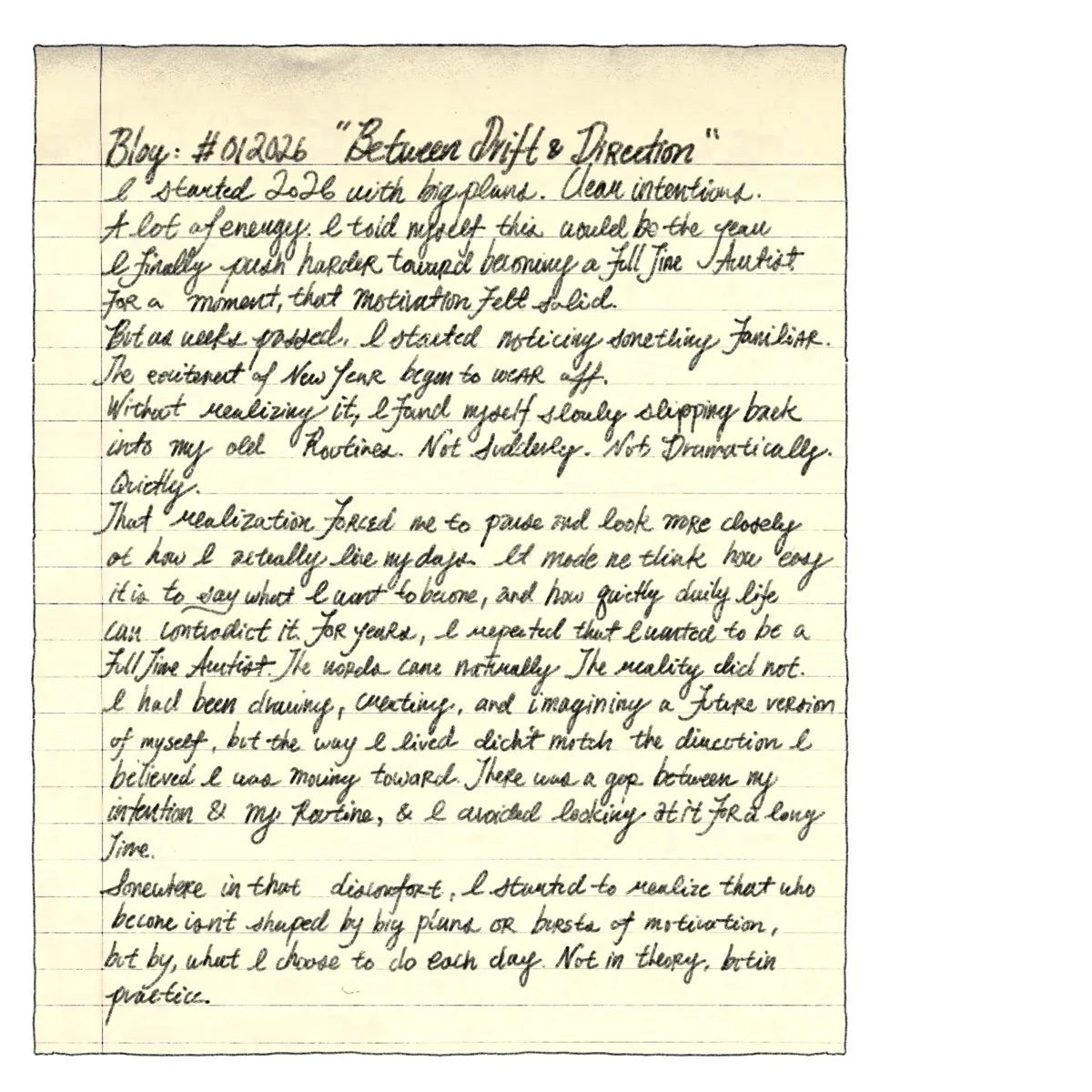
I came into 2026 with big plans. Clear intentions. A lot of energy.

I told myself this would be the year I finally push harder toward becoming a full time artist. For a moment, that motivation felt solid.

But as the weeks passed, I started noticing something familiar.

The excitement of the new year began to wear off.

Without realizing it, I found myself slowly slipping back into old routines.

Not suddenly. Not dramatically. Quietly.

That realization forced me to pause and look more closely at how I actually live my days.

It made me think about how easy it is to say what I want to become, and how quietly daily life can contradict it. For years, I repeated that I wanted to be a full time artist. The words came naturally. The reality did not.

I had been drawing, creating, and imagining a future version of myself, but the way I lived didn’t match the direction I believed I was moving toward. There was a gap between my intention and my routine, and I avoided looking at it for a long time.

Somewhere in that discomfort, I started to realize that who I become isn’t shaped by big plans or bursts of motivation, but by what I choose to do each day. Not in theory, but in practice.

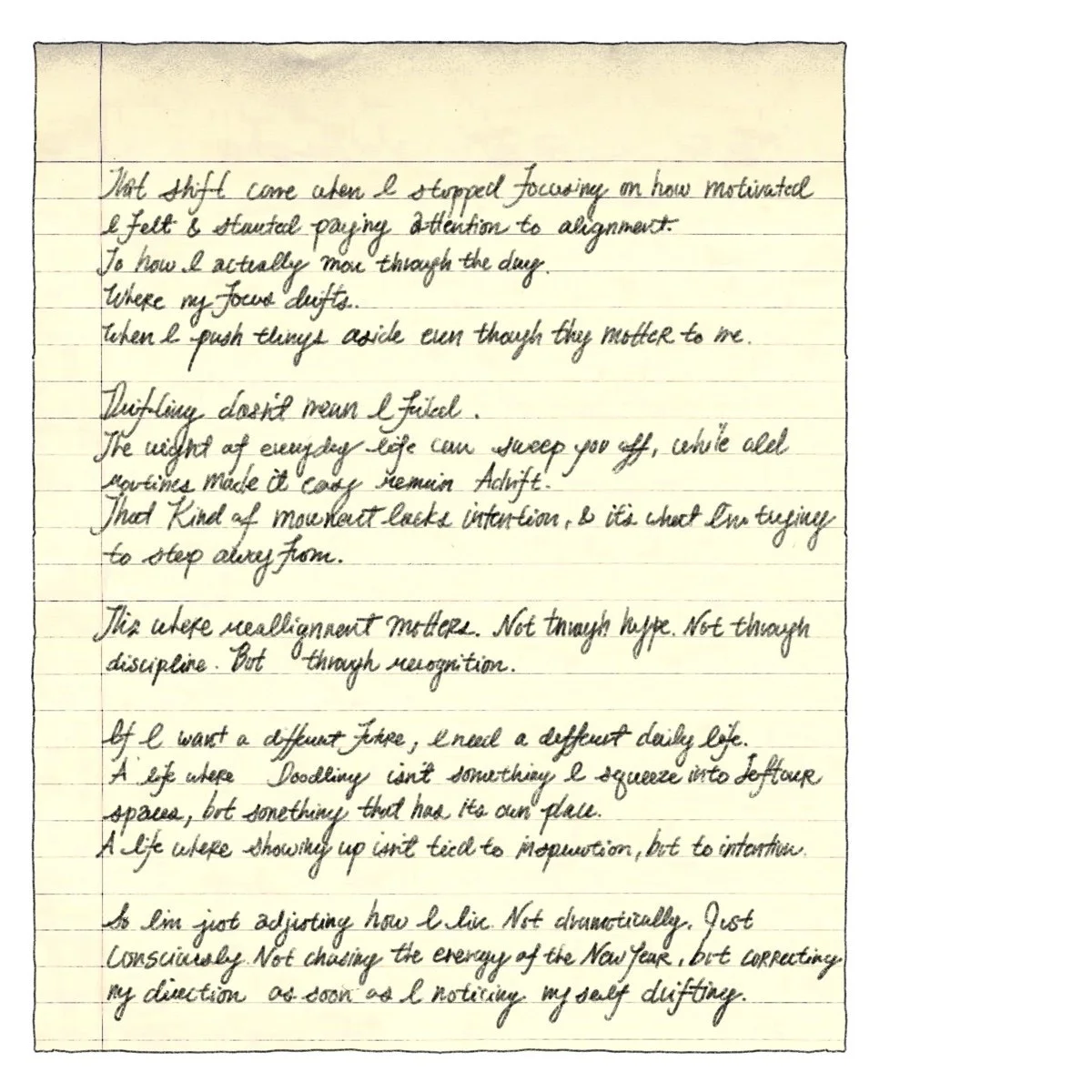
That shift came when I stopped focusing on how motivated I felt and started paying attention to alignment.

To how I actually move through a day.

Where my focus drifts.

When I push things aside even though they matter to me.

Drifting doesn’t mean I failed.

The weight of everyday life carried me forward, and old routines made it easy to remain adrift.

That kind of movement lacks intention, and it’s what I’m trying to step away from.

This is where realignment matters.

Not through hype.

Not through discipline.

But through recognition.

If I want a different future, I need a different daily life.

A life where drawing isn’t something I squeeze into leftover spaces, but something that has its own place.

A life where showing up isn’t tied to inspiration, but to intention.

So I’m adjusting how I live. Not dramatically. Just consciously.

Not chasing the energy of the new year, but correcting my direction as soon as I notice myself drifting.

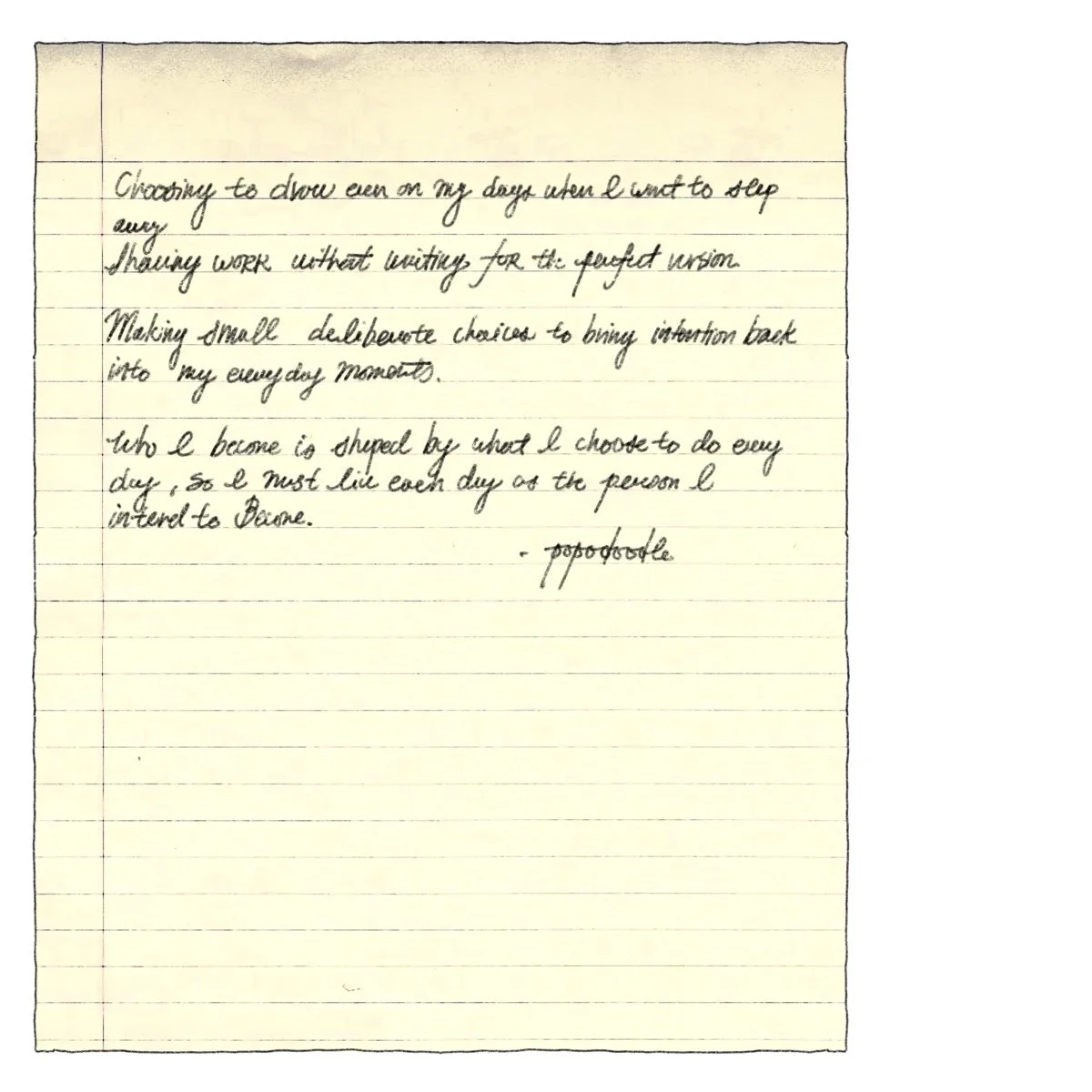
Choosing to draw even on days when I want to step away.

Sharing work without waiting for the perfect version.

Making small, deliberate choices to bring intention back into my everyday moments.

Who I become is shaped by what I choose to do every day, so I must live each day as the person I intend to become.

popodoodle
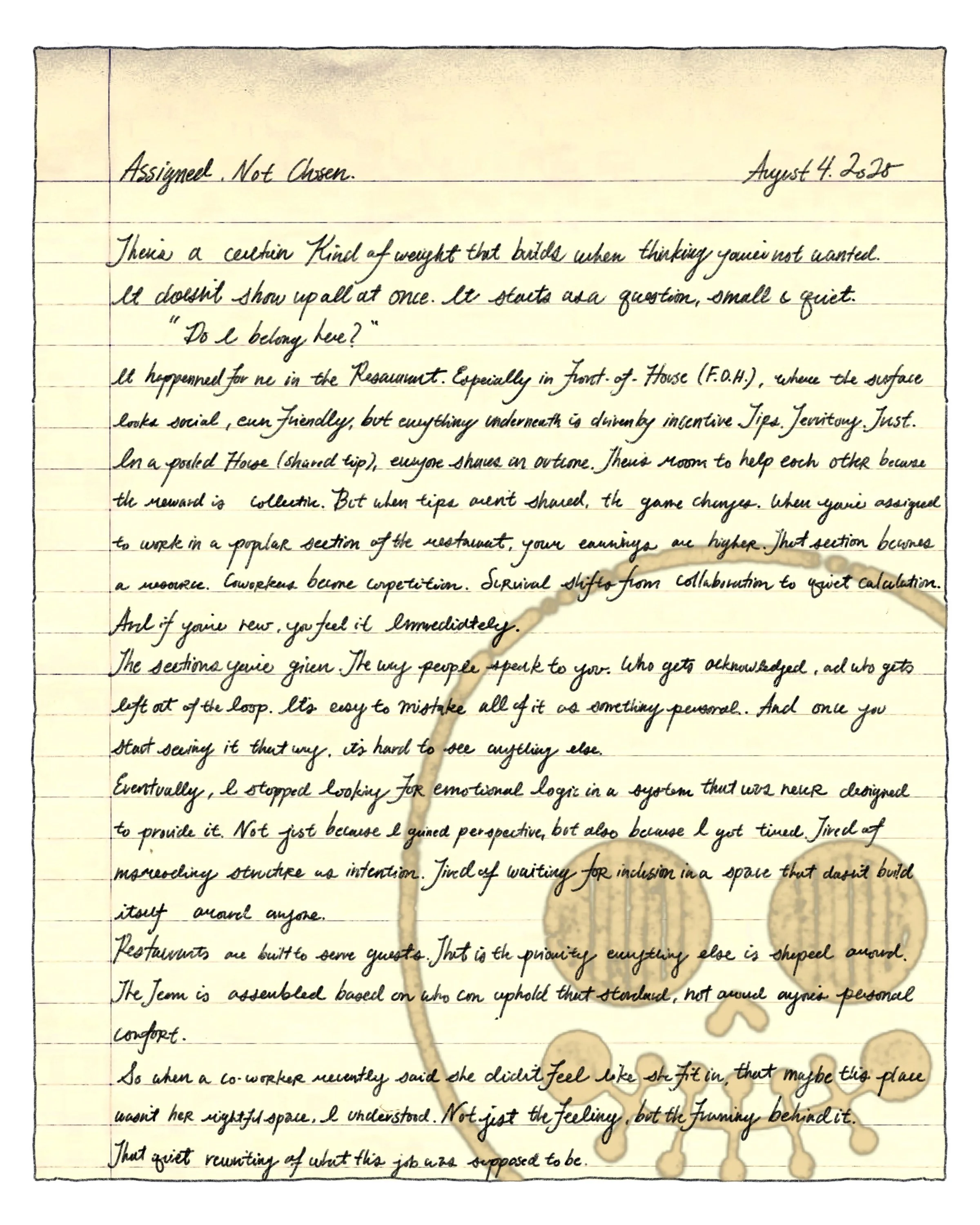
Assigned, Not Chosen. 8/4/2025

8/4/2025

Assigned, Not Chosen

There’s a certain kind of weight that builds when you start thinking you’re not wanted. It doesn’t show up all at once. It starts as a question, small and quiet. Why don’t I feel like I belong here?

It happens easily in restaurants. Especially in front-of-house, where the surface looks social, even friendly, but everything underneath is driven by incentive. Tips. Territory. Trust. In a pooled house, everyone shares the outcome. There’s room to help each other because the reward is collective. But when tips are split individually, the game changes. When you’re assigned to work in a popular section of the restaurant, your earnings are higher. That section becomes a resource. Coworkers become competition. Survival shifts from collaboration to quiet calculation. And if you’re new, you feel it immediately.

The sections you’re given. The way people speak to you. Who gets acknowledged, and who gets left out of the loop. It’s easy to mistake all of it as something personal. And once you start seeing it that way, it’s hard to see anything else.

Eventually, I stopped looking for emotional logic in a system that was never designed to provide it. Not because I gained perspective. Because I got tired. Tired of misreading structure as intention. Tired of waiting for inclusion in a space that doesn’t build itself around anyone.

Restaurants are built to serve guests. That is the priority everything else is shaped around. The team is assembled based on who can uphold that standard, not around anyone’s personal comfort.

So when a coworker recently said she didn’t feel like she fit in, that maybe this place wasn’t her rightful space, I understood. Not just the feeling, but the framing behind it. That quiet rewriting of what this job was supposed to be.

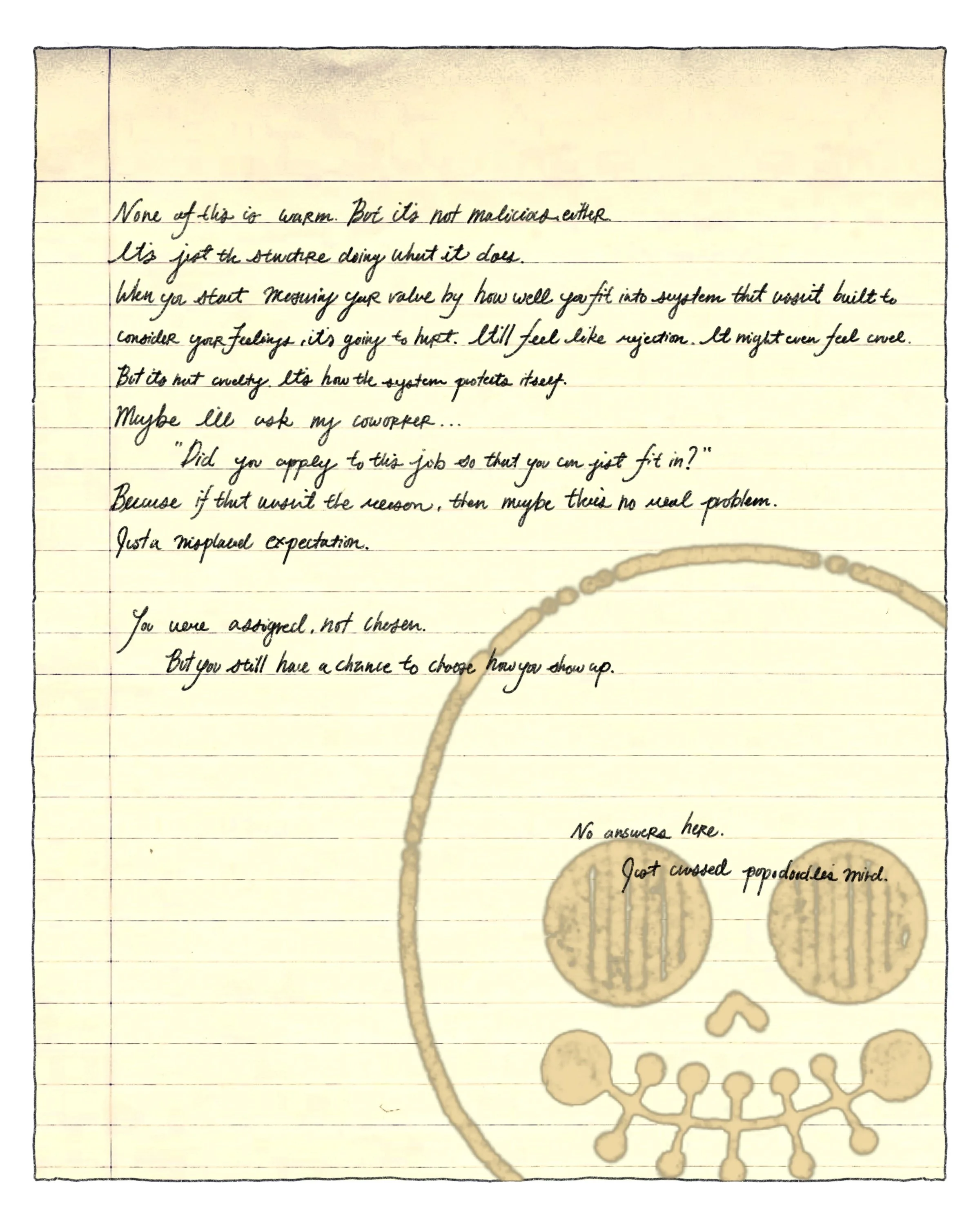
None of this is warm. But it’s not malicious either. It’s just the structure doing what it does.

When you start measuring your value by how well you fit into a system that wasn’t built to consider your feelings, it’s going to hurt. It’ll feel like rejection. It might even feel cruel. But it’s not cruelty. It’s just how the system protects itself.

Maybe ask yourself. Did you apply to this job so that you could fit in?

Because if that wasn’t the reason, then maybe there’s no real problem. Just a misplaced expectation.

You were assigned, not chosen. But you still have a chance to choose how you show up.

No answers here.

Just crossed popodoodle’s mind.

Memorize vs Understand

Memorize vs Understand

When it comes to learning—whether it’s art or anything else—there’s a big difference between memorizing and truly understanding. I learned this while studying to become a sommelier, and it completely changed how I approach doodling.

Memorizing is surface-level. You take information and try to store it in your brain without digging deeper. Understanding, on the other hand, is about asking why. It’s about breaking things down, finding the root of the information, and really making it your own.

How Wine Taught Me to Understand

When I first started studying wine, I tried to memorize facts: which grapes came from which region, and what types of wine they made. But nothing stuck, and I started to feel like I wasn’t smart enough to become a sommelier.

That’s when I shifted my approach. Instead of memorizing, I started to understand. For example, Bordeaux wine is divided into the left and right banks. Memorizing which bank is known for Merlot and which for Cabernet Sauvignon wasn’t enough—I wanted to know why.

Here’s what I learned:

• The left bank has gravelly soil that drains well and holds heat. This makes it perfect for 

Cabernet Sauvignon, a grape that ripens slowly and needs warmth.

• The right bank has clay and limestone soil, which holds moisture and stays cooler. This works

well for Merlot, a grape that ripens faster and doesn’t need as much heat.

By understanding the why, I didn’t just remember the facts—I internalized them. They made sense, so they stuck with me.

How This Applies to Art

The same thing happened with drawing. At first, I tried to memorize anatomy and techniques, but I kept forgetting. My sketches felt stiff and inconsistent.

When I switched to understanding, things changed. Instead of memorizing how to draw a hand, I studied how hands work: the bones, joints, and how they move. Instead of copying hairstyles, I learned how hair grows and flows.

Understanding gave me freedom. When I know the “why,” I don’t need to rely on references as much. I can draw from my imagination with more confidence because I’m building on a solid foundation.

Why Understanding Matters

Understanding goes beyond memorizing—it connects you to the deeper why. Whether you’re studying wine or practicing art, taking the time to break things down and dig deeper helps you retain more, learn better, and grow in your craft.

So next time you’re struggling, ask yourself: “Do I really understand this?” Dig deeper—you’ll thank yourself later.